

The area around the pool has specific requirements. The choice of material is not just an aesthetic decision, but a matter of safety and durability.
Pool tiles are available on the market in a variety of styles: wood-effect tiles and tiles made from natural materials, such as stone or terracotta. Each has its own use and aesthetic. But for the poolside area, the most important factors remain: moisture resistance, slip-resistant properties, and the material's ability to maintain its quality and appearance over time.
The Decking, especially in its modern forms from composite wood, ...is the type of decking that meets all requirements at once. This article will help you understand the different types, advantages, and key criteria for choosing poolside decking.
When deciding what type of outdoor flooring to install around the pool, the main questions are: whether it will be safe when wet, whether it will overheat and whether it will withstand constant exposure to water and chlorine.
Patio tiles, including those with a wood-grain finish, are a popular choice for balconies and covered patios, and some of them offer good slip-resistant properties, making them suitable for use around a pool.
When choosing flooring, however, it is not only durability and maintenance that are becoming increasingly important, but also the overall atmosphere that the space creates.
Wood-patterned tiles are often a compromise between practicality and aesthetics, as they struggle to capture the natural warmth and elegance of materials inspired by the texture of real wood. If the goal is to create A modern, premium pool area that exudes a sense of tranquility and features a polished design, the choice of flooring should take into account not only functionality but also the character of the space.
Decking solves these problems naturally. The wood-like texture of the surface—whether made of real wood or a blend of wood and polymers—provides better traction. The gaps between the boards allow let the water drain without detention.
Decking is comfortable to walk on even on the hottest summer days, making it a great choice for areas around a pool. The natural look of wood helps create a warmer and more polished appearance for the space.
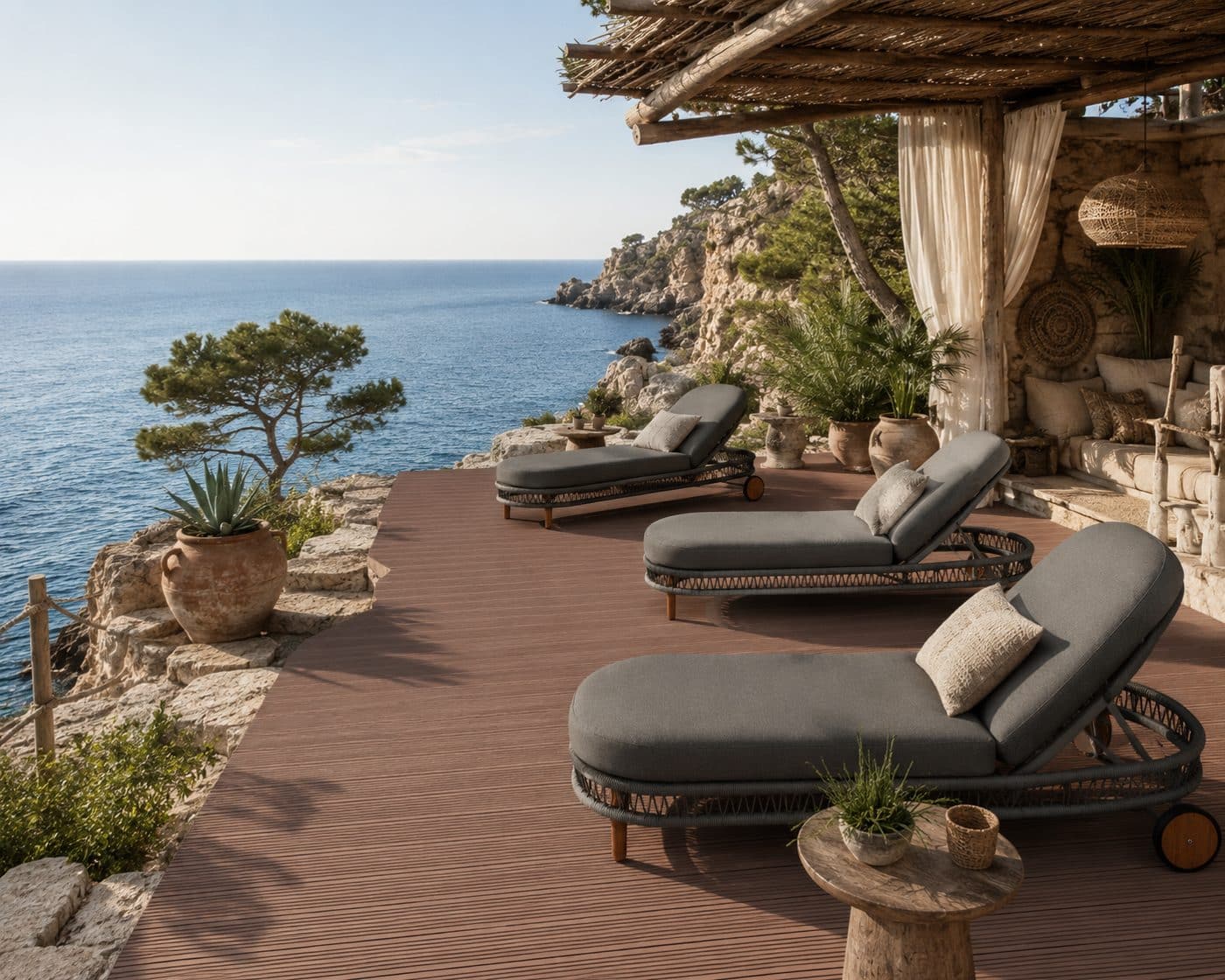
The market offers two main options: wood decking and composite decking. Wooden decking made from exotic wood species, such as ipe, teak, or thermowood, has a genuine warmth and authentic look, but requires regular maintenance with oils and wood preservatives. In cases of frequent contact with chlorinated water, this maintenance must be performed much more frequently.
Composite decking made of WPC (Wood-Plastic Composite, i.e., a wood-polymer composite) is the more practical solution for the area around the pool. It it does not swell from moisture, does not rot, does not require annual treatment, and retains its color, without the addition of any extra coatings. Its composition of wood fibers and polymer resins gives it both an attractive appearance and high durability.
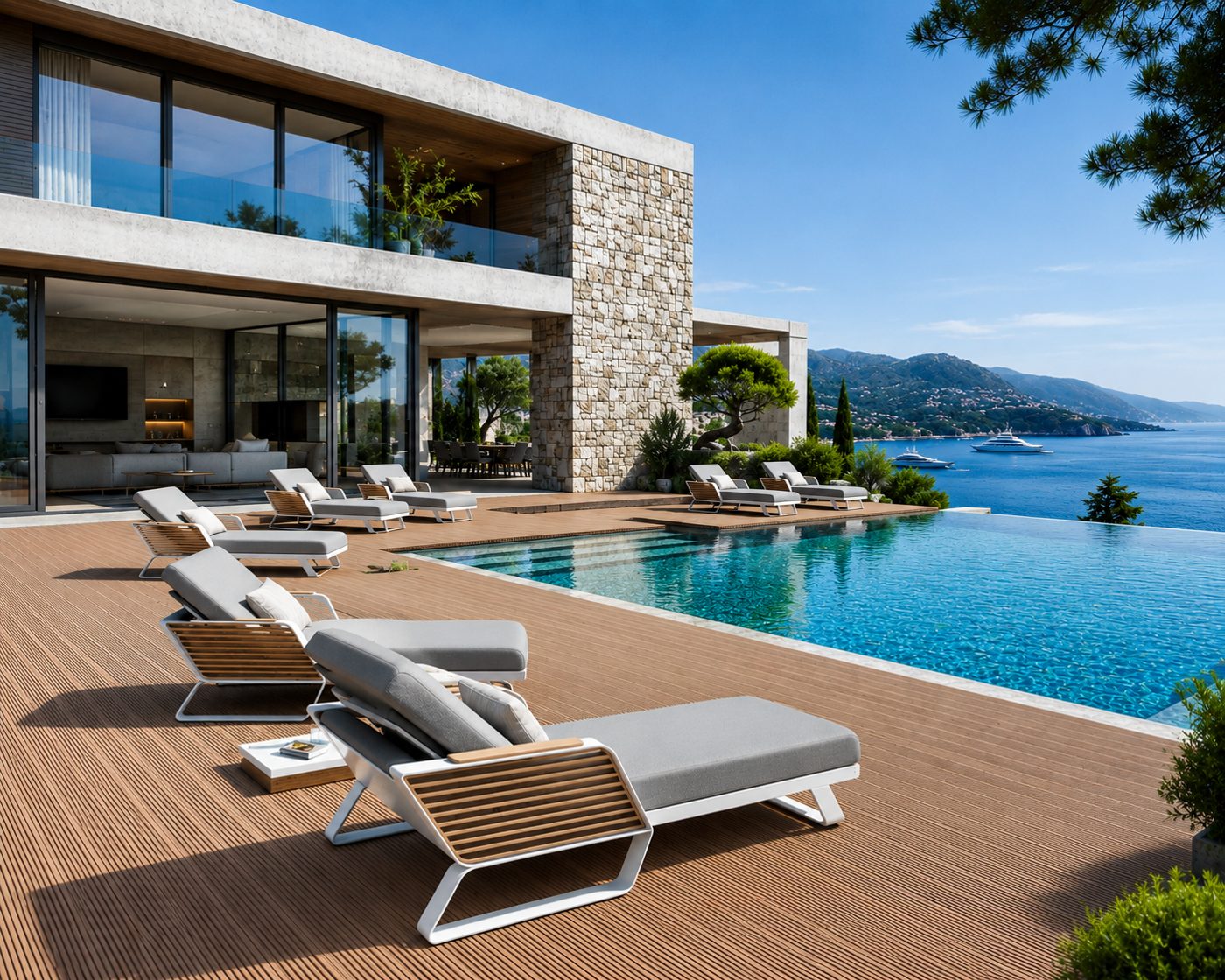
Choosing the right high-quality decking requires attention to specific technical characteristics. Around a pool, the material is exposed to a more aggressive combination of factors than on a standard deck. There are several key parameters you should keep in mind.
Summer and direct sunlight can turn some surfaces into a real hazard for bare feet. Ceramic and stone floors can heat up to temperatures above 60°C.
Durable WPC Decking they absorb heat more slowly and cool down more quickly, because the wood fibers in the composite act as a natural insulator. The result is a floor that is comfortable to walk on even on a hot summer day.
Island-style seating is often arranged around the pool bars, sofa sets, coffee tables, lounges, umbrellas, and others garden furniture, which, due to their weight, place a load on the flooring. Therefore, resistance to load and wear is an essential criterion.
It is not uncommon to construct decking areas for installing hot tubs, which creates a significant constant load. In such cases, both the weight of the structure itself and the load from the people using it simultaneously must be taken into account.
In this situation, there is a concentration of heavy weight in a small area. To support a heavier load, it is necessary to The support profiles should be spaced more closely together, and the spacers between the load-bearing elements should be closer together.
In most cases, standard lightweight WPC profiles, combined with a denser support structure, are entirely sufficient for constructing such decks. The use of solid decking profiles is also possible, but it is not always a necessary solution.
Solid WPC profiles can be used for benches, for making tabletops for outdoor tables, for fences etc. Reputable manufacturers calculate the load in kilograms per square meter, which allows you to compare products.
Safety on wet surfaces is one of the most important factors. Garden flooring around a pool—and in wet areas in general—must provide good traction under all conditions.
Proper flooring must include a ribbed or textured surface with anti-slip properties. Double-sided WPC boards typically have a ribbed surface on one side, specifically designed for areas with moisture. Check to see if the manufacturer specifies a slip resistance rating for wet surfaces.
Constant exposure to the sun is a test for any flooring material. WPC products containing UV stabilizers slow down the fading process. A high-quality finish retains its color for years.
Please note that all WPC materials undergo a slight change in shade, especially during the first season. It is normal and occurs evenly across the entire surface without damaging the material.
Water resistance is a basic requirement around the pool. Chlorinated water, rain, and splashes from the pool do not damage the surface.
It is also important that The space under the deck should be designed with a slight slope toward a drain or the yard, so that the water can drain freely without pooling. A slope of 1-2% is sufficient.
Outdoor materials are exposed to various conditions throughout the year. High-quality WPC decking can withstand freezing, snowmelt, heavy rain, and wide temperature fluctuations.
WPC Products are not attacked by woodpeckers and peckers. They also do not rot or fade. Thanks to their low moisture absorption, they reduce the risk of mold and mildew growth, which is especially important in areas with constant humidity, such as spaces around swimming pools.
Chlorine, sunscreen residue, and leaves accumulate around the pool. The recommended maintenance for WPC decking is limited to periodic washing with water and a mild cleanser.
No sanding, varnishing, or oiling is required. Wooden decking made from natural materials requires more thorough and frequent maintenance in this area.
Any deck installation around a pool requires planning, but laying the boards is not complicated if the subfloor is properly prepared. It’s important to choose the pattern in which the decking boards are laid, i.e., the so-called grid pattern. It’s a good idea to choose a schedule that won't cause any major delays when cutting the boards. Take the pattern into account for aesthetic reasons as well.
Manufacturers provide detailed installation instructions that describe the tools needed for installation and the steps for building a the supporting structure. Modern systems with invisible, concealed fasteners speed up installation and provide a clean look, with no visible bolts or clamps.

Yes, durable WPC decking is also suitable for indoor swimming areas. The material is safe for your health and does not release harmful substances in an enclosed space.
This is important for indoor pools to ensure good ventilation under the deck, since humidity is consistently high. The decking is installed on a framework of spacers (so-called “feet”) and a support profile. This system provides the necessary height and ventilation.
Decking with anti-slip certification is suitable for both indoor and outdoor spaces.
If you're planning to build a new pool and want to create a decking area around it, it's best to take certain details into account as early as the architectural design phase.
Preliminary preparation:
A well-designed decking area around the pool blends naturally into the overall look of the space and does not require costly adjustments after construction.

The overall design of the garden around the pool is entirely up to you, but there are a few principles that can help you achieve a harmonious look. If you want to highlight the blue of the water, Choose decking in light, neutral wood tones, for example: sand, beige, or light gray.
Dark shades absorb more heat. Therefore, when choosing a color for sunny areas, it’s a good idea to check whether the products are UV-resistant with special supplements, which limit heating and discoloration.
When choosing the direction in which to lay the boards, aligning them with the direction of traffic around the pool is a practical option. This way The gaps between the boards help improve drainage on the water.
If you have a larger space with separate areas, you can combine different but harmoniously complementary shades from the same outdoor decor collection. The design is completed with well-chosen outdoor lighting. If you want to highlight the evening look, add recessed LED deck lighting profiles or individual ground lights around the perimeter of the pool.
Wood-look tiles are often seen as an alternative to pool decking, but there are significant differences between the two options.
With tiles, water tends to pool on the surface more easily, and if the slope is insufficient, puddles may form. With decking, water flows through the joints between the planks and drains more effectively, which is an advantage in a constantly damp environment.
Wood-look tiles are usually a more budget-friendly option, but they struggle to capture the feel and look that decking creates around relaxation areas. Decking gives the space a more finished look and creates a more comfortable environment around the pool.
In addition to its aesthetic qualities, composite decking is also highly resistant to moisture, temperature changes, and heavy use – factors typical of areas around pools. Therefore, when looking for a long-lasting solution that combines good looks with high functionality, decking is often a better choice than standard wood-look tiles.
One of the main differences is that The solid decking profile can withstand a greater load and is more suitable for applications where a concentrated load is expected on the flooring. It is also often preferred in cases where the profile’s cross-section remains visible after installation.
This is common in designs where the decking is not fully recessed but remains exposed on the sides—for example, when constructing benches, seats, or cladding, where the profile is visible in cross-section. In these situations, the solid profile creates a more finished appearance, and there is no need for an additional profile to achieve this finish.
The hollow decking profile, on the other hand, is lighter and does not place unnecessary stress on the substrate to which it is installed. Thanks to its lighter weight, it is easier to handle and install, and is usually a more affordable option. This is precisely why hollow profiles are the preferred choice for standard decking in residential spaces.